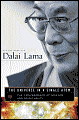
Last July, Cardinal Christoph Schönborn, the archbishop of Vienna, wanted to turn back the clock in the catholic church. Breaking with two generations of catholic scholars, Schoenborn did his best to portray the teaching of the catholic church as being in opposition to a Darwinian explanation of the development of different life forms (see below for his NY Times article). It seems to me that the Dalai Lama, just as the late Pope John Paul II, is a smarter fellow than Schoenborn. Esther Sternberg makes these interesing observations in her review of the Dalai Lama’s new book The Universe in a Single Atom: The Convergence of Science and Spirituality.
The Dalai Lama makes this point in his discussion of the Buddhist view of Earth and its relation to celestial bodies, whose “sizes, distances [etc.] are flatly contradicted by the empirical evidence of modern astronomy.” He suggests that “Buddhism must abandon many aspects of the Abhidharma cosmology,” citing the Buddhist dictum that “to uphold a tenet that contradicts reason is to undermine one’s credibility; to contradict empirical evidence is a still greater fallacy.” This point is sure to be controversial for those who hew more rigidly to Buddhist tradition. The Dalai Lama, however, does not limit his controversial proposals only to the side of Buddhism. Many scientists may disagree with his plea for including subjectivity and compassion in science. Furthermore, although he clearly supports Darwin’s theory of evolution as “a coherent account of the development of life on this planet and the various principles underlying it, such as natural selection,” he questions some aspects of the theory. Strict Darwinians may balk at his proposal that the theory falls short on several counts, mainly in its lack of explanations of the origin of life and the origin of “sentience” or consciousness, although the author bolsters his arguments with ample logic. Healthy debate, however, does not require agreement. It simply requires a continuing dialogue, open-mindedness, respect, and thoughtful consideration of other points of view. This is certainly consistent with Buddhist philosophy. (Science 3 February 2006:Vol. 311. no. 5761, pp. 611 – 612)
Reading these words from the Dalai Lama, I can understand much better why during the last half decade many Europeans left behind their Christian background to find spiritual satisfation in Far Eastern religions.
And here is the piece by Schoenborn, who makes the big error of assuming meaning is only possible when given by an external power (GOD). I don’t know any evidence that children who were not planned by their parents find their lives any less meaningful than children who were intended. Accidents can lead to profoundly meaningful lives! Why should this not be the case with the entire human species?
Finding Design in Nature
By CHRISTOPH SCHöNBORN (NYT) 964 words
Published: July 7, 2005
Vienna – EVER since 1996, when Pope John Paul II said that evolution (a term he did not define) was ”more than just a hypothesis,” defenders of neo-Darwinian dogma have often invoked the supposed acceptance — or at least acquiescence — of the Roman Catholic Church when they defend their theory as somehow compatible with Christian faith.
But this is not true. The Catholic Church, while leaving to science many details about the history of life on earth, proclaims that by the light of reason the human intellect can readily and clearly discern purpose and design in the natural world, including the world of living things.
Evolution in the sense of common ancestry might be true, but evolution in the neo-Darwinian sense — an unguided, unplanned process of random variation and natural selection — is not. Any system of thought that denies or seeks to explain away the overwhelming evidence for design in biology is ideology, not science.
Consider the real teaching of our beloved John Paul. While his rather vague and unimportant 1996 letter about evolution is always and everywhere cited, we see no one discussing these comments from a 1985 general audience that represents his robust teaching on nature:
”All the observations concerning the development of life lead to a similar conclusion. The evolution of living beings, of which science seeks to determine the stages and to discern the mechanism, presents an internal finality which arouses admiration. This finality which directs beings in a direction for which they are not responsible or in charge, obliges one to suppose a Mind which is its inventor, its creator.”
He went on: ”To all these indications of the existence of God the Creator, some oppose the power of chance or of the proper mechanisms of matter. To speak of chance for a universe which presents such a complex organization in its elements and such marvelous finality in its life would be equivalent to giving up the search for an explanation of the world as it appears to us. In fact, this would be equivalent to admitting effects without a cause. It would be to abdicate human intelligence, which would thus refuse to think and to seek a solution for its problems.”
Note that in this quotation the word ”finality” is a philosophical term synonymous with final cause, purpose or design. In comments at another general audience a year later, John Paul concludes, ”It is clear that the truth of faith about creation is radically opposed to the theories of materialistic philosophy. These view the cosmos as the result of an evolution of matter reducible to pure chance and necessity.”
Naturally, the authoritative Catechism of the Catholic Church agrees: ”Human intelligence is surely already capable of finding a response to the question of origins. The existence of God the Creator can be known with certainty through his works, by the light of human reason.” It adds: ”We believe that God created the world according to his wisdom. It is not the product of any necessity whatever, nor of blind fate or chance.”
In an unfortunate new twist on this old controversy, neo-Darwinists recently have sought to portray our new pope, Benedict XVI, as a satisfied evolutionist. They have quoted a sentence about common ancestry from a 2004 document of the International Theological Commission, pointed out that Benedict was at the time head of the commission, and concluded that the Catholic Church has no problem with the notion of ”evolution” as used by mainstream biologists — that is, synonymous with neo-Darwinism.
The commission’s document, however, reaffirms the perennial teaching of the Catholic Church about the reality of design in nature. Commenting on the widespread abuse of John Paul’s 1996 letter on evolution, the commission cautions that ”the letter cannot be read as a blanket approbation of all theories of evolution, including those of a neo-Darwinian provenance which explicitly deny to divine providence any truly causal role in the development of life in the universe.”
Furthermore, according to the commission, ”An unguided evolutionary process — one that falls outside the bounds of divine providence — simply cannot exist.”
Indeed, in the homily at his installation just a few weeks ago, Benedict proclaimed: ”We are not some casual and meaningless product of evolution. Each of us is the result of a thought of God. Each of us is willed, each of us is loved, each of us is necessary.”
Throughout history the church has defended the truths of faith given by Jesus Christ. But in the modern era, the Catholic Church is in the odd position of standing in firm defense of reason as well. In the 19th century, the First Vatican Council taught a world newly enthralled by the ”death of God” that by the use of reason alone mankind could come to know the reality of the Uncaused Cause, the First Mover, the God of the philosophers.
Now at the beginning of the 21st century, faced with scientific claims like neo-Darwinism and the multiverse hypothesis in cosmology invented to avoid the overwhelming evidence for purpose and design found in modern science, the Catholic Church will again defend human reason by proclaiming that the immanent design evident in nature is real. Scientific theories that try to explain away the appearance of design as the result of ”chance and necessity” are not scientific at all, but, as John Paul put it, an abdication of human intelligence.